Purpose and goals
The ARTIC tiled amplicon-based sequencing approach has been instrumental in responding to outbreaks and epidemics like those of Ebola, Zika, and SARS-CoV-2. The technology is fast, portable, and robust, enabling real-time surveillance and epidemiological tracking of virus outbreaks.
We have built a training package to facilitate delivering hands-on experience spanning the full workflow, from sample preparation to data interpretation, simulating genomic epidemiology using synthetic nucleic acid controls. The participants will work on a simulated outbreak scenario for data interpretation and identifying actionable insights. This training package aims to deliver realistic and applicable learning outcomes, addressing common challenges and confounding factors encountered when applying genomics during outbreaks.
The broader aim is to strengthen local viral genome sequencing capacity and share knowledge through open-access, hands-on training in ARTIC methodologies. This distributable package will provide a comprehensive, end-to-end instruction based on best-practices, protocols, and approaches as recommended by the ARTIC network.
Target audience
The target audience for this training package is researchers and/or staff working in public health microbiology laboratories performing infectious diseases research, real-time virus surveillance, and/or outbreak epidemiology. Participants should ideally:
- Have a foundational knowledge in molecular biology
- Be interested or have prior experience in applying genomics during outbreaks or public health investigations
The training class size is defined based on the host institution needs, and availability of instructors and funding; the current recommendation is for 4-8 groups of 2-3 people each.
Learning Objectives
On completion of the course, participants can expect to be able to:
- Explain the advantages (and limitations) of portable viral sequencing technology for real-time epidemiological surveillance
- Understand sample preparation and the use of appropriate experimental controls within the context of viral sequencing
- Understand the principles of primer design for viral genome sequencing and perform PCR amplification of viral genomes
- Prepare and load sequencing libraries for ONT sequencing
- Monitor the sequencing run output
- Process raw sequencing data through bioinformatics pipelines, interpret the quality control outputs, and generate reports
- Understand the components of a phylogenetic tree and interpret phylogenetic trees and epidemiological data
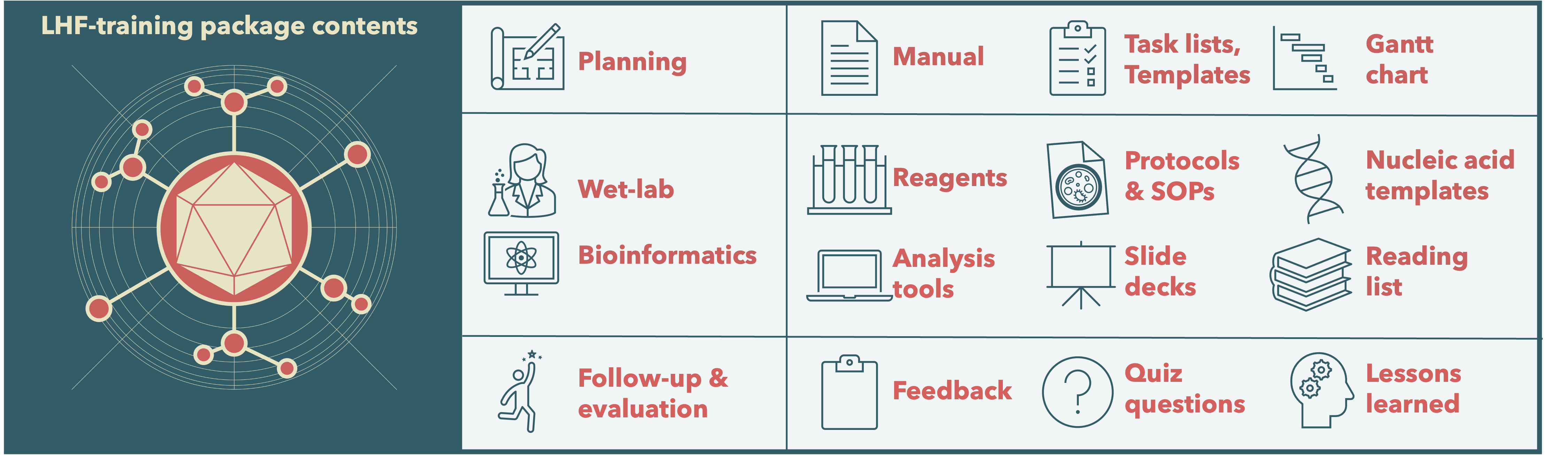
Package contents
Future development
Target Training Profile (TTP)
The training package is envisioned as a collaboration between ARTIC and local academic and/or public health institutes. In-scope for the development of the current version of this package are the features defined in Minimum Characteristics in the table below. Characteristics that will be included in future versions are listed under Optimal Characteristics.
| Feature | Minimum Characteristics (v1) | Optimal Characteristics (v2+) |
|---|---|---|
| Curriculum Content | Core ARTIC protocol overview, overview of primer design, PCR, library prep and loading, sequencing, basic bioinformatics analysis, interpretation and epi inferences | Reagent substitution, various sample types (see nucleic acid template) allowing participants to simulate various starting points (RT, PCR, etc), phylodynamic analysis, range of scenarios (outbreaks, zoonoses, vector-borne, endemic pathogen surveillance and emerging AMR threats) with increased sample sizes |
| Nucleic Acid Template | Synthetic nucleic acids, mimicking viral genome evolution, provided as DNA and used for training | Synthetic nucleic acids, mimicking viral genome evolution, provided as RNA or armoured RNA to be used for training. Option also to use as quality controls |
| Training Format | In-person, ARTIC-network instructor-led workshop. Four to eight groups (typically 2–3 people each) processing 12 samples each | Synthetic nucleic acid templates available upon request (reagent bundle for e.g. 12 participants) allowing for self-paced, self-study setup with local trainers delivering the material independently; online support |
| Target Audience | LMIC researchers and PHM staff with molecular biology skills and basic understanding of sequencing | Adaptable for various skill levels |
| Language | English | Multilingual support (French, Portuguese, etc.) |
| Resource Availability | ARTIC providing all material required (other than equipment), open access resources | ARTIC providing template nucleic acids, open access resources, and advertised on website |
| Evaluation and Assessment | Participation tracking, simple pre- and post-course quizzes. Continuous improvement using post-course surveys | Certified content. Continuous improvement using post-course surveys and report sent to ARTIC network |
| Documentation | Training manuals and protocols, prep guides, lecture slides, simulating material | Training manuals with relevant guides, document templates, FAQs, simulating material, option for online demos/videos/talks |
| Scalability | Single-cohort training | Replication in local institutions, train-the-trainer modules available |
| Cost | Costs fully covered by ARTIC network via grant funding from the Wellcome Trust | Simulating material provided by ARTIC, optional support for local deployment (LIAS) |